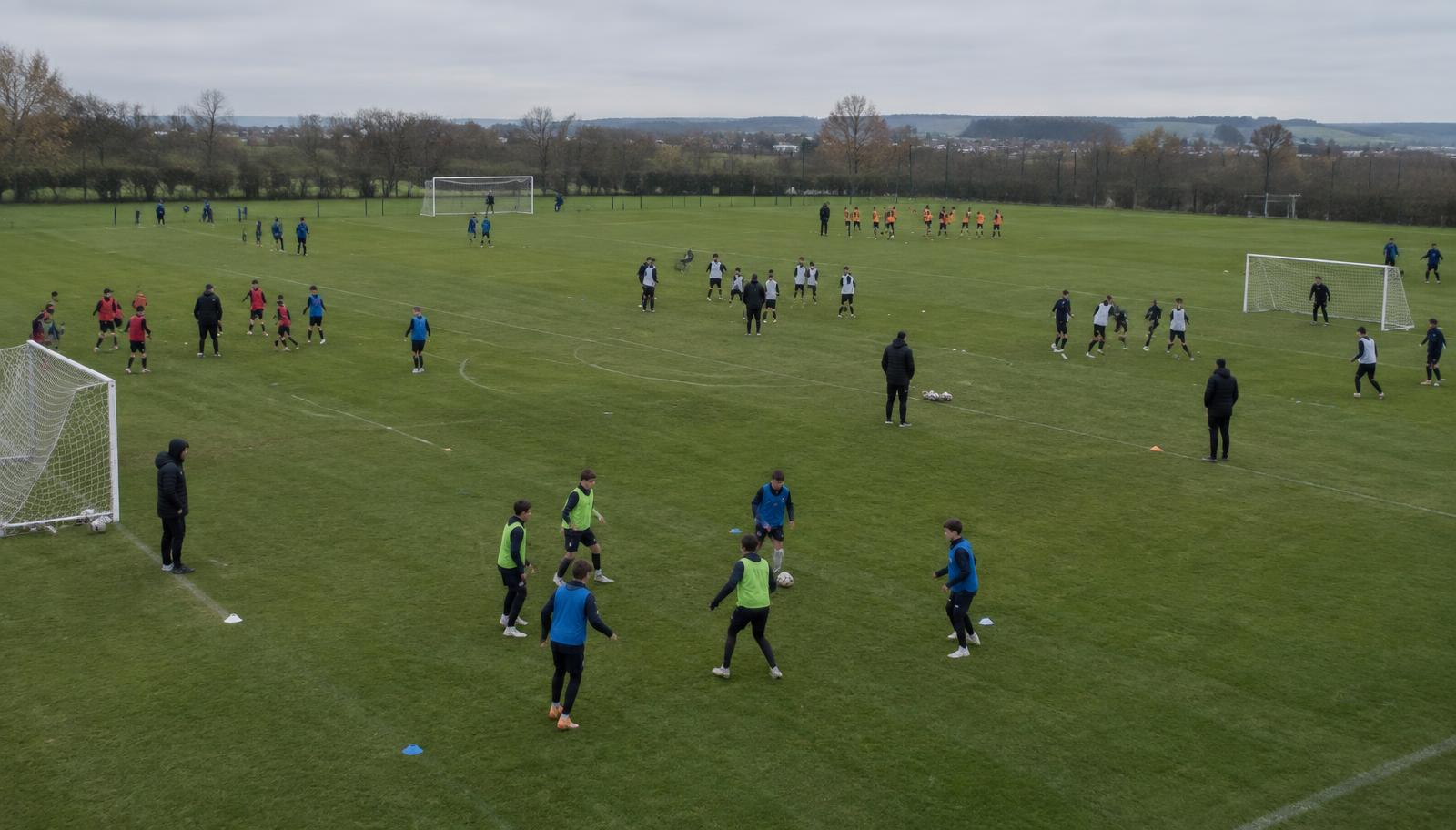
Quick answer: Academies do not grow in a straight line. They move through four phases, and each phase has a different job. Up to 50 players the job is pure acquisition. From 50 to 100 you keep acquiring while you build your first retention systems. From 100 to 200 growth stops being about effort and starts being about numbers. Past 200 you grow by leverage: better margins per player, a second location, or a franchise model. Working on the wrong job for your phase is the single most common reason academies stall.
Why phases matter more than tactics
Most academy owners consume advice built for a different size of business. A 35-player academy reads about lifetime value dashboards and builds a spreadsheet instead of knocking on school doors. A 180-player academy keeps buying ads while 40% of its families quietly leave every season. The tactic is not wrong. The timing is.
The four phases below come from patterns we see repeatedly at Football Marketing Agency working with academies across 20+ locations at very different stages. Treat them as diagnostic, not prescriptive: find the phase that describes your bottleneck today, and do that phase's job before you reach for the next one.
Phase 1: 0 to 50 players — everything is acquisition
At this size you have no data, no reputation beyond word of mouth, and no room for sophistication. You have one problem: not enough people know you exist.
What to build
- One offer, clearly priced. Not five programs. One flagship program with a clear age band, a clear schedule, and a clear price. Confused parents do not buy.
- A trial that leads somewhere. A free or low-cost first session with a scripted follow-up within 24 hours. A trial without a follow-up is a donation.
- Manual outreach. Schools, community groups, local clubs, parent WhatsApp groups, and door-to-door conversations at the fields you already use. At this stage the founder is the marketing channel.
- Proof. Photo and video of real sessions, and three to five parent testimonials. You are selling belief, because you do not yet have scale.
What to stop doing
Stop building a brand book. Stop comparing management software. Stop adding programs to "give parents options." Every hour not spent putting a human in front of a prospective family is an hour spent avoiding the real work.
The number that matters
New enrolments per month. That is it. If it is not increasing, nothing else matters yet.
The failure mode
Perfectionism. Owners stall at 20 to 30 players because they are building the version of the academy they want at 200 players instead of filling the one they have.
Phase 2: 50 to 100 players — acquisition plus your first retention systems
Around 50 players something changes: you can no longer remember every family's situation. Players start leaving without you noticing until the invoice fails. Growth feels like filling a bucket with a hole in it.
What to build
- A written onboarding sequence. The first 30 days decide the next 30 months. Welcome message, what to bring, what to expect, who to contact, a coach introduction, and a check-in call at day 21.
- Attendance tracking with a trigger. Two missed sessions in a row should generate a personal message, not a report nobody reads.
- A structured parent touchpoint. A short progress note every 6 to 8 weeks. Parents do not churn because of coaching quality. They churn because they cannot see progress.
- Automatic recurring billing. Chasing payments manually at 80 players consumes an evening a week and creates awkward conversations that end memberships.
What to stop doing
Stop running acquisition as a series of one-off pushes before each season. Your funnel should run continuously at low volume, so a bad month of enrolments does not become a bad year.
The numbers that matter
Monthly churn rate (players who left ÷ players at start of month) and trial-to-member conversion rate. Anything above roughly 5% monthly churn will cap your growth no matter how good your marketing is.
The failure mode
Treating retention as a personality trait. Owners say "our families love us" while 8 to 10 players quietly disappear each month. Affection is not a system.
Phase 3: 100 to 200 players — know your numbers
This is the phase where academies either become businesses or stay expensive hobbies. At 100+ players you have enough volume that decisions must be made with arithmetic rather than instinct. You cannot feel your way to a pricing decision that affects 140 families.
The numbers you must be able to state from memory
- CPL (cost per lead): total marketing spend ÷ number of enquiries generated.
- CAC (customer acquisition cost): total marketing and sales spend ÷ number of new members enrolled.
- LTV (lifetime value): average monthly fee × average number of months a player stays. Use gross margin, not revenue, if you want a decision-grade number.
- Rent cost per player: total facility cost for a location ÷ active players at that location.
- Coaching cost per player: total coach wages ÷ active players. Watch this by session, not by month — one under-filled group can distort a whole program.
- Location profitability: revenue from a site minus every cost attributable to that site. Blended averages hide the site that is losing money.
The relationship that governs everything is LTV to CAC. If LTV is not comfortably above three times CAC, you are buying growth you cannot afford. The fix is almost never "spend less on marketing" — it is usually "increase LTV by extending how long players stay."
What to build
- A single monthly dashboard with those six numbers, reviewed on the same day every month.
- Session-level utilisation tracking, so you can see which groups are 40% full and merge or move them.
- A pricing review with real inputs. Most academies at this stage are underpriced by 10 to 20% and have never tested it.
- A second-in-command who runs operations, so the founder can work on the business.
The failure mode
Revenue grows, profit does not. Owners add players and add costs at the same rate, then wonder why 160 players feels no better financially than 90 did.
Phase 4: 200 to 250+ players — leverage, second location, or franchise
Past roughly 200 players, growth from the same site gets expensive: pitch hours run out, prime-time slots are full, and each extra player costs more to serve than the last. The job changes from adding players to adding leverage.
The three leverage routes
| Route | What it is | Best when | Main risk |
|---|---|---|---|
| Margin leverage | Raising revenue per existing player: camps, private sessions, tiered memberships, gear, tournaments | Your facility still has capacity in off-peak hours | Overloading staff and diluting the core program |
| Second location | Replicating the model at a new site under your own ownership | Unit economics at site one are documented and repeatable | Exporting chaos instead of exporting a system |
| Franchise or licence | Other operators run your model under your brand and systems | You have a written playbook and proven demand in multiple markets | Quality control and legal complexity |
The honest test before opening a second location: can you write down exactly how site one gets a player from first enquiry to their sixth month, in enough detail that a competent stranger could execute it? If not, a second location will not double your business. It will double your problems.
What to build
- An operations manual covering coaching curriculum, session structure, enrolment scripts, billing, complaint handling, and hiring.
- A site P&L template so each location is judged on its own numbers.
- A management layer: site leads with clear targets, not just senior coaches with extra keys.
The four phases side by side
| Phase | Primary job | Key metric | Typical ceiling cause |
|---|---|---|---|
| 0–50 | Acquisition only | New enrolments per month | Too few people know you exist |
| 50–100 | Acquisition + first retention systems | Monthly churn, trial conversion | Players leaving as fast as they join |
| 100–200 | Know your numbers, deepen retention | LTV:CAC, cost per player | Revenue grows, profit does not |
| 200+ | Leverage and replication | Profit per location | No written system to replicate |
How to use this
Pick the phase that matches your current bottleneck, not your ambition. Do that phase's job for one full season before moving on. Academies that jump ahead build dashboards they cannot fill and open locations they cannot staff; academies that move in order tend to pass each ceiling once and never come back to it.
Frequently asked questions
How many players does a soccer academy need to be profitable?
There is no universal number, because profitability depends on rent, coach cost, and fee level. A useful test instead: take your monthly fixed costs and divide by your gross margin per player. That is your break-even player count. Many single-site academies land somewhere between 60 and 120.
What is a healthy churn rate for a youth soccer academy?
Below roughly 3% per month is strong; 5% is manageable; above 7% means retention work should outrank marketing work immediately. At 7% monthly churn you replace your entire roster in about 14 months.
Should I raise prices or add players?
At 100+ players, a 10% price increase usually adds more profit than 10% more players, because extra players carry extra coaching and facility cost while a price increase carries almost none. Test the price increase on new joiners first.
When is the right time to open a second location?
When your first site is at or near capacity in prime hours, is profitable on its own P&L, and its operating procedures are written down. Missing any one of the three and it is too early.
What should I track if I can only track three numbers?
New enrolments per month, monthly churn rate, and gross margin per player. Almost every other academy metric is derived from those three.
Does this apply to leagues and tournaments too?
The phase logic does. The metrics change: for events you track registrations per edition, repeat-team rate, and profit per event rather than churn and LTV.