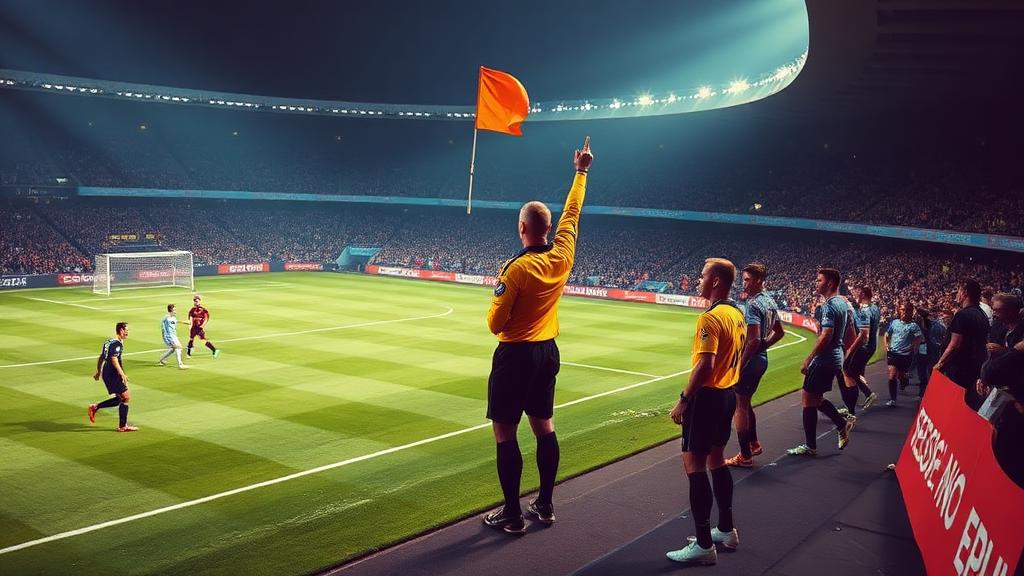
As an academy owner, coach, or even an informed parent, you know that few things cause more confusion and sideline chaos than a contested offside call. Misunderstanding this fundamental rule not only costs teams opportunities on the field but also erodes trust between parents, coaches, and referees. This guide moves beyond a simple definition to provide a strategic framework for teaching, coaching, and managing the offside rule within your organization.
Quick Answer
A player is in an offside position if any part of their head, body, or feet is in the opponents' half of the field and closer to the opponents' goal line than both the ball and the second-to-last opponent. A player is only penalized for being in this position if, at the moment the ball is played by a teammate, they become involved in active play by interfering with an opponent, touching the ball, or gaining an advantage.
The 5 most common mistakes (and how to fix them)
Mistake 1: Coaching the "Position" Instead of the "Moment"
What goes wrong: Most of the confusion surrounding offside stems from a single point of failure: players, parents, and even developing coaches watch the attacker's position when they receive the ball. They see a player alone behind the defense and assume it's offside. This leads to incorrect frustration, as the infraction is determined not upon receipt of the pass, but at the exact moment the ball is kicked by the attacker's teammate. A forward can be miles "onside" when the ball is played and run onto it into a space that is, by then, behind the last defender.
The fix: The key is to train the "snapshot" principle. Coaches should explicitly teach players (and assistant referees, for that matter) to take a mental snapshot of the entire field at the moment of the pass. Freeze-frame analysis in video sessions is the single most effective tool for this. During training, use coaching cues that emphasize this timing. Instead of yelling "You're offside!" after the play is over, use proactive cues like "Check your run!" or "Time it with the pass!" as the play develops. A great small-sided drill is a 3v2 to goal, where the coach stands on the sideline and yells "NOW!" when the passer strikes the ball. At that moment, all players freeze, allowing the attackers and defenders to see the exact relationship between the runner, the defense, and the ball at the critical moment.
Mistake 2: Misinterpreting "Involved in Active Play"
What goes wrong: The official FIFA Laws of the Game state that an offside position only becomes an offense if the player is "involved in active play." This is not a single action but a category with three distinct sub-clauses, and a failure to differentiate them leads to mass confusion. Many believe that if a player in an offside position doesn't touch the ball, they cannot be penalized. This is incorrect and misses two critical scenarios that referees must judge in a split second.
The fix: Educate coaches and players on the three specific ways to be "involved," using clear, scenario-based language.
- Interfering with play: This is the most straightforward. It means playing or touching a ball passed or touched by a teammate. This is the one everyone understands.
- Interfering with an opponent: This is where subjectivity and confusion begin. It includes actions like clearly obstructing an opponent’s line of vision (e.g., standing directly in front of the goalkeeper), challenging an opponent for the ball, or making an obvious action which clearly impacts on the ability of an opponent to play the ball. A forward in an offside position who makes a run towards the ball, forcing a defender to change their path to intercept, has interfered—even if they never get near the ball. The defender's action was dictated by the offside player's action.
- Gaining an advantage by being in that position: This is the most misunderstood clause. It primarily applies to rebounds. If a player is in an offside position when a shot is taken, and the ball rebounds to them off the goalpost, crossbar, or the goalkeeper, they are penalized for offside. They have gained an advantage from their illegal starting position. Critically, this also applies to a rebound or deflection off an opponent (defender) when it's not a "deliberate play." A defender sticking a leg out in a pure reflex action is a deflection; a defender mis-controlling a pass they were deliberately trying to play resets the offside phase. Teaching this distinction is advanced but necessary for teams in competitive leagues like ECNL or Girls Academy.
Mistake 3: Over-coaching Offside in 7v7 and 9v9 Formats
What goes wrong: Academy directors see their U9 and U10 players getting caught offside and instinctively demand coaches "fix it." This often results in coaches yelling at 8-year-olds about a complex spatial-temporal rule, which stifles creative runs and encourages players to simply stand behind the ball. It's developmentally inappropriate and runs counter to the objectives of US Soccer's Player Development Initiatives (PDIs).
The fix: Embrace the build-out line. The build-out line, used in 7v7 (U9/U10) soccer, mandates that the defending team retreat behind this line on a goal kick. More importantly for this topic, offside can only be called between the build-out line and the goal line. This creates a large "safe zone" in the middle of the field where players can learn to make forward runs without fear of being penalized. Academy curriculum should be designed to leverage this rule, not fight it. For U9-U10, the coaching focus should be on *movement* and *timing*, not the abstract concept of offside. Drills should reward players for making runs behind the defense and for strikers checking their shoulders to see defenders. Delay formal offside instruction until the 9v9 (U11/U12) format, where the rule applies from the halfway line but the field size is still reduced, making it easier to grasp.
Mistake 4: Allowing Parents (and Staff) to Litigate Sideline Calls
What goes wrong: A parent, convinced their child was onside, screams at a teenage referee. A coach questions every close call, creating a hostile environment. This behavior doesn't change the call, but it does damage your club's reputation, hurt referee retention, and teach players to make excuses instead of taking responsibility for their positioning and timing. From a business perspective, a reputation for having an unruly sideline is a significant liability that can deter new families and make it harder to attract and retain quality referees for your events.
The fix: This is a cultural and operational challenge that requires a top-down solution from the club's administration.
- Mandatory Pre-Season Parent Education: Hold a meeting or distribute a clear, club-branded guide (and video) explaining the basics of offside, especially the subjective "interfering with an opponent" and "gaining an advantage" clauses. Emphasize that these are judgment calls and that the club has a zero-tolerance policy for referee abuse.
- Empower the Director of Coaching (DOC): The DOC should be the point of contact for coaching-related rule questions, not the referee during or after a game. Your DOC's job is to educate coaches on how to teach the rule and how to model correct sideline behavior.
- Focus on Controllables: Train coaches to redirect player and parent frustration. Instead of complaining about the call, the post-play coaching point should be, "Okay, the call was made. Next time, let's start your run a split-second later to make sure there's no doubt." This reframes the problem from the referee's judgment to the player's execution.
Mistake 5: Teaching the Offside Rule Only as a Restriction
What goes wrong: Players learn offside as a purely negative rule—something to avoid. They become timid, their runs become predictable, and they fail to see how the offside rule can be used as a tactical weapon by both the offense and defense. Elite players and teams understand how to manipulate the offside line to their advantage.
The fix: Dedicate practice time to the tactical implications of the rule for players U13 and older.
- For Attackers - Beating the "Trap": Teach forwards how to "bend" their runs. Instead of running in a straight line towards the goal, they should run laterally along the defensive line, staying onside, and then accelerate into the space behind the defenders the moment the ball is played. Another key skill is the "check back," where a forward who has strayed offside takes two quick steps back onside right before the pass is made.
- For Midfielders - The Killer Pass: The passer is as responsible for a successful attack as the runner. Train midfielders to play with their heads up, looking for the forward's run first. The pass should be "to space," leading the runner into the area behind the defense, not played directly to their feet.
- For Defenders - The Offside Trap: This is a high-risk, high-reward strategy that requires immense coordination. Teach the defensive line to move as a single unit, stepping up in unison just before the opponent plays a through ball to catch the attacker in an offside position. This should only be taught to advanced, disciplined teams (typically U15+) as a failed trap results in a clear breakaway for the opposition. Practice this with a vocal leader at center-back giving a single, clear command ("Step!").
Comparison of Offside Application in Youth Soccer
Understanding how the offside rule progressively changes is vital for creating a coherent, long-term player development pathway at your academy. The implementation is not uniform and aligns with the developmental age and stage of the players.
| Format / Age Group | Offside Rule Application | Primary Coaching Focus | Common Parent/Player Misconception |
|---|---|---|---|
| 4v4 (U6-U8) | No offside rule is in effect. | Ball mastery, 1v1 skills, basic spacing. Discourage "goal hanging" through coaching, not rules. | N/A - Rule does not exist, though parents may still complain about goal hanging. |
| 7v7 (U9-U10) | Offside is only enforced between the build-out line and the goal line. | Making forward runs, timing movements, playing balls into space behind the build-out line. | "He's offside!" when a player is between the halfway line and the build-out line (which is a legal position). |
| 9v9 (U11-U12) | Full offside rule is enforced from the halfway line, per FIFA Laws of the Game. | Introducing the "snapshot" moment, checking shoulder to see the last defender, bending runs to stay onside. | Confusing an offside position with an offside offense; believing any player behind the defense is automatically offside. |
| 11v11 (U13+) | Full offside rule with all nuances (interfering, gaining advantage, deliberate play vs. deflection). | Tactical use of the rule: coordinated defensive "trap," advanced offensive runs, recognizing when a teammate is interfering. | "It hit the defender, he can't be offside!" (Failing to distinguish between a deliberate play and a deflection). |
How to apply this at your academy
Moving from theory to practice requires a systematic approach. Here are actionable steps you can implement across your club to improve understanding and execution of the offside rule.
- Develop a Club-Wide Offside Curriculum. Don't leave this to individual coaches. Create a simple, age-appropriate progression document that aligns with the comparison table above. Specify the learning objectives for 7v7, 9v9, and 11v11. For example, U10s focus on "running forward," U12s focus on "timing the run," and U14s focus on "beating the trap." This ensures consistency and prevents coaches from teaching concepts that are too advanced or outdated.
- Implement "Freeze" Drills. The most effective way to teach the "moment of the pass" is to physically stop it. During small-sided games or attacking pattern drills, the coach keeps the whistle. When a through ball is played, the coach blows the whistle loudly. All players must freeze in place instantly. This provides a living tableau for the coach to walk onto the field and point out the exact positions of the attacker and the second-to-last defender at the critical moment.
- Host an Annual Referee Q&A Session. Invite a senior referee assignor or instructor to speak to your coaches and parents before the season. Frame it not as a complaint session, but as a professional development opportunity. Having a neutral, authoritative figure explain the subjective elements of "interfering" and show video clips of tough calls can build immense goodwill and empathy. This simple act positions your club as a partner in the game, not an adversary.
- Use Video Analysis for Key Teams. For your top competitive teams (U13+), video is non-negotiable. Isolate 5-10 clips from each game focusing on offside situations—both correct calls and missed opportunities. Review with the team to praise well-timed runs that stayed onside and to analyze why an offside trap worked or failed. Linking visual evidence to coaching points accelerates learning dramatically faster than verbal instruction alone. This can be a major value-add in your sales and marketing messaging to prospective parents.
Frequently asked questions
What part of the body is used for an offside decision?
Any part of the head, body, or feet can place a player in an offside position. The arms and hands of all players, including the goalkeeper, are not considered. If an attacker's head or torso is ahead of the second-to-last defender, but their arms are not, they are still considered to be in an offside position.
Can a player be offside from a throw-in, goal kick, or corner kick?
No. A player cannot be penalized for offside if they receive the ball directly from a goal kick, a throw-in, or a corner kick. This is a crucial exception that creates significant scoring opportunities. Smart teams will practice placing players in what would otherwise be an offside position on these set pieces to gain an advantage.
How does the "gaining an advantage" clause in the offside rule work?
This applies when a player in an offside position receives the ball after it has rebounded or been deflected off the goalpost, crossbar, an opponent, or the goalkeeper. The key is that the player's offside position at the start of the play gave them an unfair advantage to be the first to reach the rebound. It's a penalty for being in the right place at the right time, but having started from an illegal position.
Why did US Soccer introduce the build-out line for youth soccer?
The build-out line has two main purposes. First, it encourages teams to learn to play the ball out from the back rather than having the goalkeeper punt it downfield. Second, by moving the offside line up, it creates more space for attackers to learn to make runs and for defenders to learn to track them without the constant interruption of offside calls, promoting a more fluid and developmentally appropriate game.
Is it an offside offense if a player is in their own half of the field?
No. A player cannot be in an offside position while they are in their own half of the field. The halfway line is the boundary. Even if a player is ahead of the ball and all opposing players, they are considered onside as long as they are on their side of the halfway line when their teammate plays the ball.
Does a deflection off a defender negate an offside call?
This is a critical nuance. A simple deflection—an instinctive, reactive touch where the defender does not have control of their body or the ball—does not negate an offside position. However, if the defender makes a "deliberate play" (e.g., attempts to control a pass, makes a clear header to a teammate, or tries to kick the ball clear) and misplays it to an attacker who was in an offside position, the attacker is now considered onside because the defender deliberately played the ball, resetting the phase of play.
Mastering the nuances of the offside rule transforms it from a source of frustration into a tactical advantage for your players and a point of clarity for your entire club community.